
Portable toilet rental for events and building sites, starting small
Everyone needs a toilet, and no app can deliver one: a few units on a pickup can start a repeat-income business.
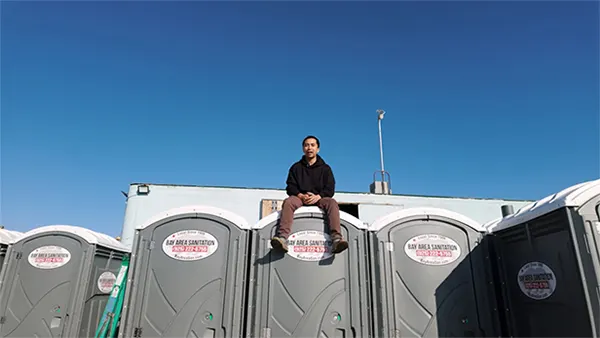
- Startup cost
- $3k–10k
- Mid budget · $1k–10k
- Difficulty
- Medium
- Revenue potential
- Full-time living
- Time to launch
- Weeks
- Seen in
- Thailand
Costs and revenue are rough estimates based on the source and may differ by country.
Rent a handful of portable toilets to events and construction sites, deliver them by pickup or small trailer, and earn from rentals plus weekly cleaning.
The idea
You rent portable toilets to event organisers (concerts, festivals, weddings, markets) and to construction sites and parks. You deliver the units, collect them and keep them clean. The case behind this profile is Bay Area Sanitation in the San Francisco Bay Area, started in 2023 by Daniel Tom, aged 31, with one vacuum truck and 100 units. According to the business, it now runs nearly 2,000 units, 12 trucks and 19 staff, earned $3.1 million in 2024 and $4.3 million in 2025, and was profitable from its first year.
Its prices show the model: a standard unit starts at $160 a month on long-term hire, including weekly cleaning, while an event hire costs $239–399. Most income comes from long-term clients, because rent and weekly cleaning repeat every month. That is a big company; the one-person version starts with a few units and the same logic. The need exists wherever there are festivals and building work, including Thailand.
Who it fits
This suits someone with a pickup or small trailer, a yard to store units, a strong stomach and willingness to start early (the founder gets up at 4 a.m.). Experience in sales or customer service helps: Daniel worked part-time in customer service for a rental firm, then seven years in sales. Event deliveries fall at weekends, so you can begin beside a job, but weekly cleaning of long-term units is weekday work. It works in any city with outdoor events or active building sites.
Costs and revenue
The source puts one unit at about $800 and a vacuum truck at about $160,000; Daniel estimates a newcomer would need around $250,000 for a full operation. The smallest version avoids the truck. As an estimate, expect roughly $3,000–10,000 for 4–10 units, straps or a small trailer, deodoriser, disinfectant, paper, signage and insurance. Pay a licensed waste contractor to empty the units, or hire a tank service, until volume justifies your own equipment.
Revenue logic: long-term rental plus weekly cleaning, with event hires as a bonus. If you charge something close to $160 a month per unit in a market that supports it, eight units on site work bring roughly $1,300 a month before costs. A realistic early take-home is perhaps $800–3,000 a month, an estimate that depends heavily on local prices. Daniel reports a net margin of about 22% at scale, with wages around 30% of revenue.
Risks and pitfalls
- Waste rules: disposal needs licensed sites and sometimes permits. Check local law first and use a licensed contractor.
- Hygiene standards: each unit must be pumped, deodorised, scrubbed, disinfected and restocked. One dirty unit loses a client; use a checklist and photos.
- Idle units: events are seasonal and weather-dependent. Aim for long-term site contracts to cover fixed costs.
- Damage and theft: use written contracts, deposits and clear pickup dates.
- Cash tied up: every extra unit costs money before it earns. Add units only when existing ones are booked.
How to start
6 stepsVisit local event organisers and site managers to learn current rental prices and what they dislike about suppliers.
Check waste disposal laws and find a licensed contractor or dump site to empty units after use.
Buy 4–10 durable units and cleaning supplies, and arrange transport by pickup or a small trailer.
Offer builders a long-term hire with weekly cleaning, and pitch wedding and market organisers for weekend events.
Price long-term hire per month with cleaning included, and events per hire, with a deposit for damage.
Reinvest earnings into more units, then consider your own tank equipment once bookings are steady.
More in: Services

 United States
One-person direct mail service for local shops and restaurants
Local shops still want customers on their doorstep, and you can design, print and deliver the postcards.
 Saudi Arabia
Memory clinic: turning families' old photos and tapes into books
Old photos fade and cassettes decay, so families will pay to turn them into one book.
 United Kingdom
Paid monthly book club for adults in your own town
A UK consultant turned a reading habit into a 350-member club that brings in about $6,400 a month.
Door-to-door ride and escort service for seniors in Thailand
Older people don't just need care at home. They need a safe way to get out and live.
More from this day

 Brazil
Collecting salon hair clippings for oil-absorbing mat makers
Barbershop floor sweepings are becoming raw material for ocean oil-spill barriers.
Wood-burned drumsticks and home decor from a home workshop
A hobby woodburning pen turns plain drumsticks into custom gifts that musicians happily pay extra for.

Abacus mental arithmetic classes for children in Africa
Beads, a few textbooks and a corner of your home can become a monthly-fee maths club for local children.

 India
Homemade thekua sold from your own kitchen in India
A family recipe for Bihar's thekua turned one Bengaluru kitchen into a snack brand shipping across India